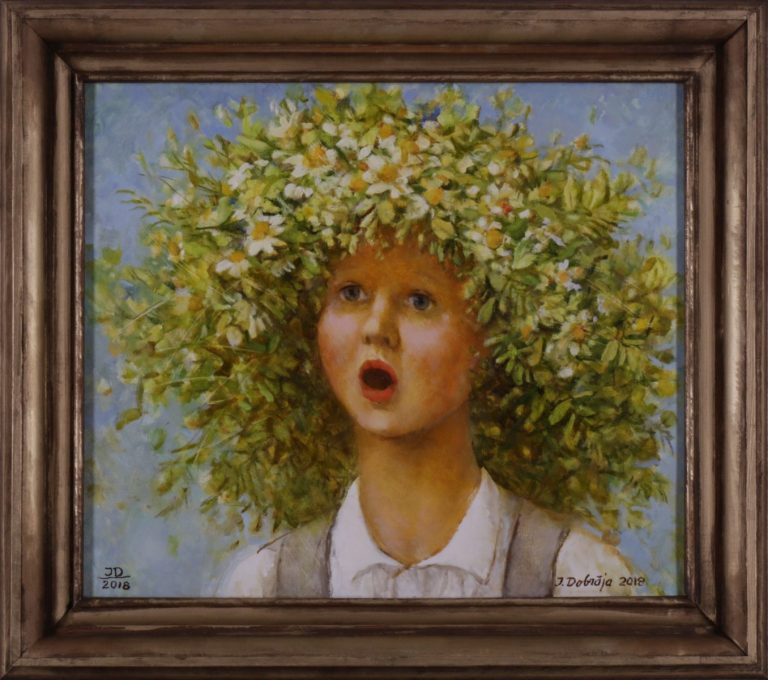
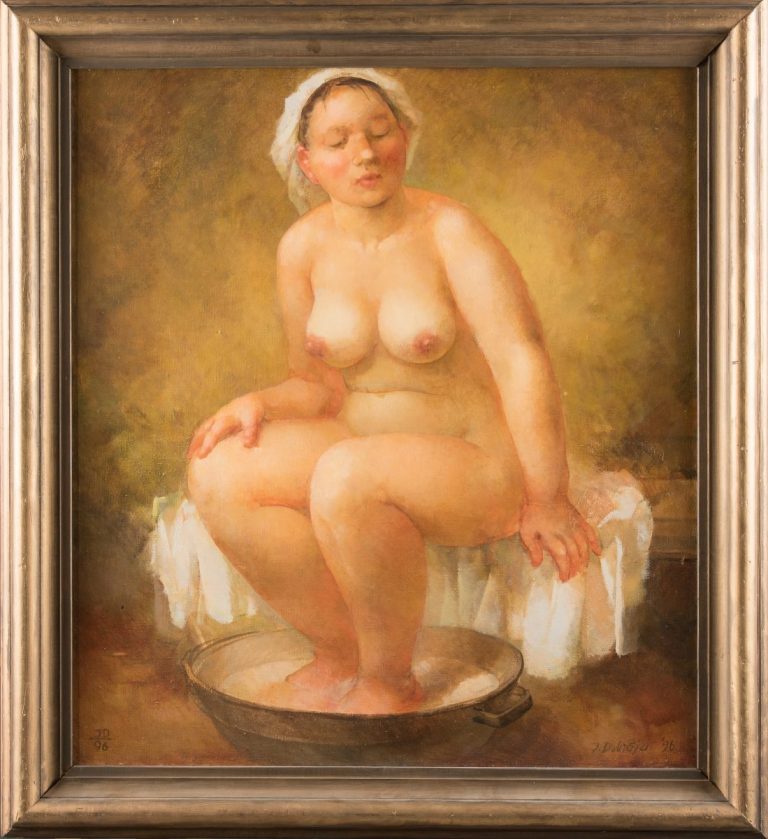
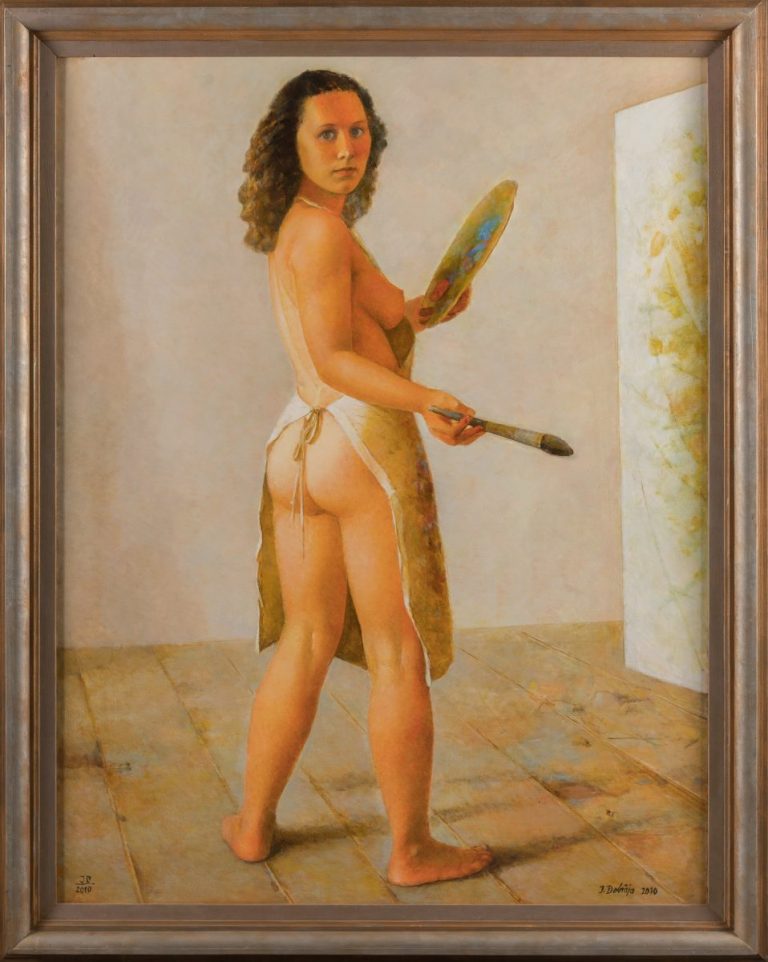
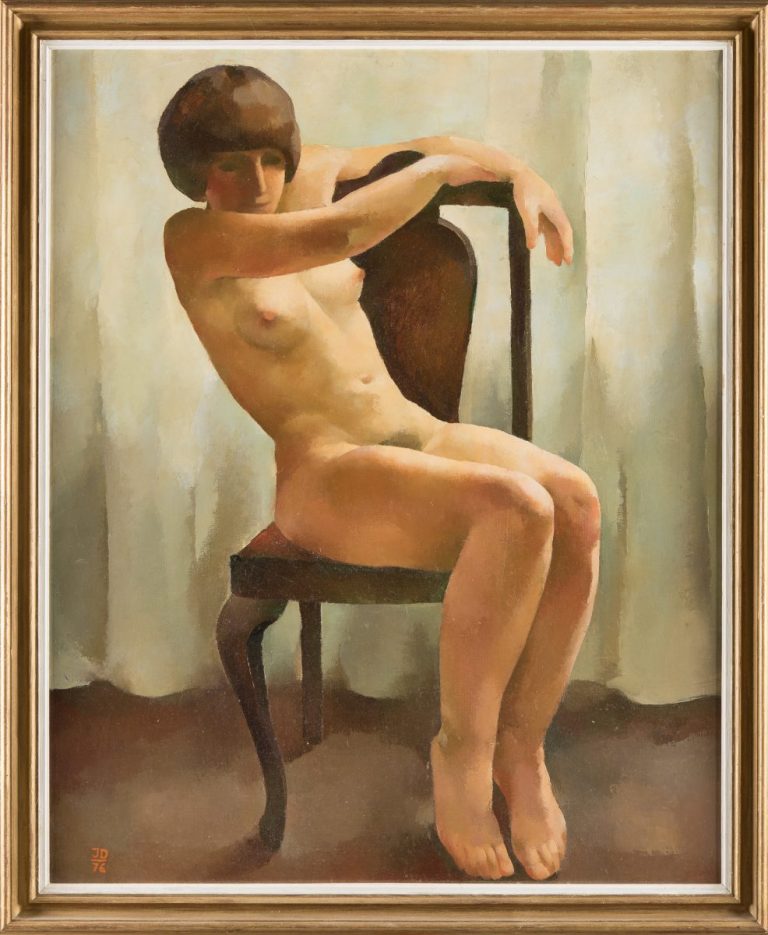
The painting of Inta Dobraja is very close to the classical tradition – one can see delicately refined artistry, harmony, simplicity of theme and content. The works of Dobraja are realistic, based on tonally spatial painting that is characteristic to Latvian classical art. The artist mainly depicts flowers, still life, nudes and figurative compositions. Her works are dominated by women whose external appearance can be characterized with strong, round forms. They usually are portrayed in domestic interior, the kitchen, field work or with children.
“In her still life she uses ordinary tableware and flowers which surround us every day and that become aristocratically sophisticated in the interpretation of Inta Dobraja. Also nudes – the young girls with Rubenesque figures that are still unaware of the sinful nature of their nudity, and mature wives whose full and alluring body shapes are associated with fullness of life – are depicted in everyday situations (for example, while washing their feet) in a simplified environment. Human in Inta Dobraja’s painting doesn’t come to internal contradictions or conflicts with the world surrounding it: he is the whole world and perfect for himself. In her works the material world provides the joy of living, that feeling of happiness when the very existence itself gives the pleasure to be on this diverse world.” M. Brancis
The artist herself describes her work as follows: “There are several themes to whom I always return – it’s still life with white tableware, female nudes (with Midsummer wreaths on their heads), portraits and flowers. I can paint them again and again, and it seems that the working process gives me joy. I paint very slowly, but almost every day. No picture occurs faster than in a month. I am sitting, looking and evaluating for a long time. Then I read a newspaper a bit and continue to look again. I match and tune every painting. As it gets closer to the painting being done, as slower the working process becomes. For me also the inner feeling of the work is very important. But, what it will turn out to be I know from the very beginning. It’s mostly light and warm.”
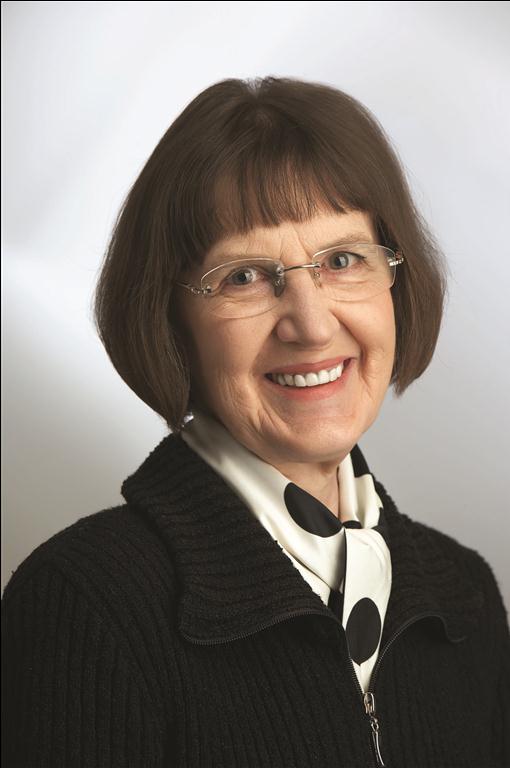
Inta Dobraja is born in Riga on 14th of January, 1940. Studied at the Ceramics Department of Riga School of Applied Arts (1954-1959), in 1967 graduated from the Painting Department of the Art Academy of Latvia with a work “Ceramists” (led by Eduards Kalnins).
Inta Dobraja is a member of Artists’ Union since 1972. Exhibited since 1968. Most important solo exhibitions have been in Daugavpils (1977, 1986, with K. Dobrajs), Straupe, Jelgava, Limbazi, Kraslava (1986, with K. Dobrajs), Riga (1987), Vaidava, Nogale palace(1988). Artist regularly participates in national and international exhibitions.
The works can be found in Latvian and foreign museums, like, Latvian National Museum of Art, the collection of Artists’ Union of Latvia, University of Latvia, Daugavpils Regional and Art Museum, Kraslava History and Art Museum, The State Tretyakov Gallery in Moscow, private collections in Latvia, Russia, USA, Denmark, France, Finland, Italy, Japan, Greece, Sweden, Israel, Poland, Estonia, Australia etc. The artist has been awarded with a prize for the best work in fine arts from the Ministry of Culture of Latvia (1981), with all-union TSSI silver medal for the painting “Morning” (1981).
Source:
Dobrāja, Inta. Māksla un arhitektūra biogrāfijās, I. Riga: Latvijas enciklopēdija, 1995, p.29.