Annuss Augusts
1893 - 1984
Augusts Annuss (1893-1984) was born in Liepaja, in transport worker’s family. Augusts Annuss studied at Kiev Art School (1913 – 1915), Baron Stieglitz Central School for Technical Drawing in Petrograd (now – St. Petersburg) (1915-1918), in the evenings he attended the Society for the Encouragement of the Arts’ School in Petrograd.
In 1926 he finished Figurative painting class led by J. Tillberg at the Art Academy of Latvia with work “At the Shipyard of Liepaja”.
He worked as scenic painter at the Liepaja New Theatre (1921-1923), was a teacher (1929-1940, 1941-1944) and professor (1944) at Art Academy of Latvia. For study purposes he visited countries like France, Spain, Germany, Austria, Holland, Belgium, Finland, England and Italy during the 1920’s and 1930’s. From 1923 he began to participate in exhibitions of The Union of Independent Artists. In 1928 Augusts Annuss joined The Latvian Artists Association, in the beginning of the 1930’s – association “Sadarbs”. He took part in foreign exhibitions organized by association “Sadarbs”, Culture Fund and the state.
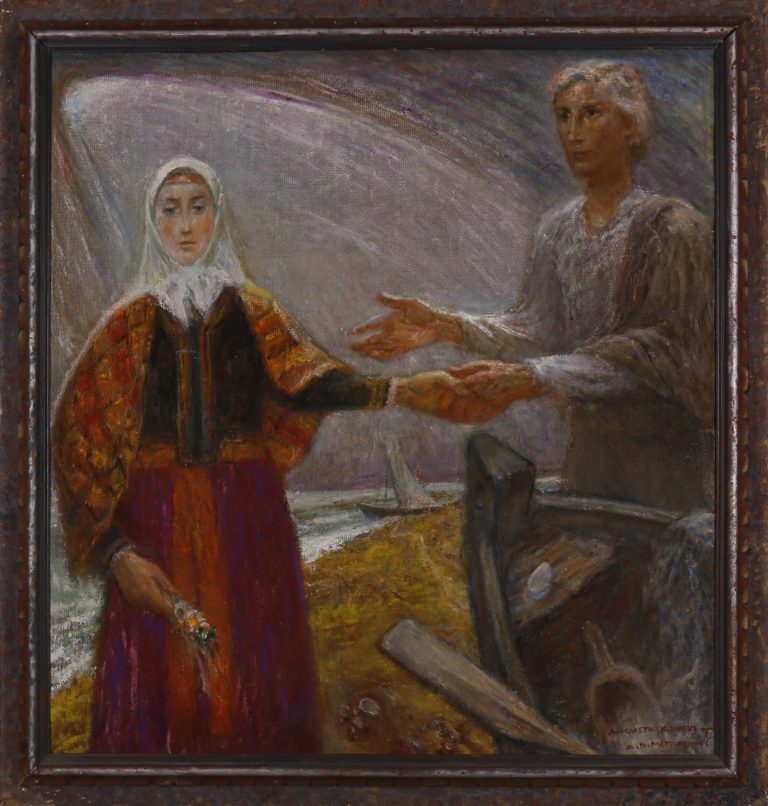
The most important works of Augusts Annuss’s early period are connected with travels in Kurzeme, where in Rucava, Alsunga, Dunika etc. the artist had seen the lives of people and old customs. Already in this early period the artist was declared as an outstanding drawer, creator of complicated compositions and forceful master of color. Originally paintings of A. Annuss highlighted the importance of drawing and line, but at the end of 1920’s it was all about the coloring and the lightness of a brush stroke. In 1930’s the artist mostly painted fishermen’s wives, farmers, worker in their everyday and leisure time, discovering the vitality and beauty of woman’s body. During this time, his color choice had become silvery grey, the atmosphere – rippling, composition – monumental.
In the time of exile many symbols appeared in his paintings. The brush pattern had become more nervous, the color – more subtle. The artist repeatedly painted the nation’s symbol of immortality – the kokle(traditional Latvian music instrument) player.